I connected recently with Margaret Ferguson on Twitter, and what caught my eye was her mentioning her interest in applied aesthetics. Beginning her career as a cosmetologist, she turned to philosophical aesthetics, and this is her story.
Guest post by Margaret Ferguson:
When I was in middle school in 2002, I moved to Henderson, Kentucky, from Austin, Texas; besides the casual southern drawl, the two towns were about as opposite as day and night. Immediately I missed the multicultural aspects of Austin, and once arriving in the small town of Kentucky, I stuck out like a sore thumb, and so did the perpetual issues of class and race, which would eventually fashion my perspective on cultural and societal issues. It was almost as if I had traveled back in time. There was a significant focus on skin color, wealth, dating, and popularity. Moving shaped my life in multiple ways, forcing me to adapt to this new social environment, which inevitably aroused my curiosity about aesthetics and, more precisely, applied aesthetics because our aesthetic decisions influence our culture, ethics, and politics.
During middle school, I began to observe the inner workings of my new rural community. I started watching and piecing together the social hierarchy of middle school, where I became fascinated with trends. I noticed that most of those who enjoyed their time at school were the rough-neck, four-wheeler-riding white boys who wore camouflage pants, jackets, and muddy boots. By contrast, the small group of African American boys, who always matched their clothes to their pristine sneakers, had a more difficult time. They were called racial slurs, and if they didn’t fit the aesthetic of their collective due to poverty, it appeared to be even more difficult for them, receiving bullying even from their own communities.
There was a similar aesthetic landscape for the young girls; however, sexuality was an additional layer to be considered. I quickly learned that wearing conservative Abercrombie & Fitch or Hollister fitted t-shirt tops and low-rise jeans brought you more positive attention and hid you from bullying in my female social circles. I begged my parents to take me to the mall to buy “the accepted” female fashions; however, my socioeconomic situation prevented me from hiding myself, which ostracized me from the “popular kids.” And thankfully, it did because instead, it allowed me to pick my own aesthetic instead of choosing the macro trend. I got to choose an aesthetic that inspired my passion for art, music, and social issues. Upon seeing my first skinny jean, studded belt, dirty sneakered, band-tee-wearing adolescent, I knew that was the group I belonged to, so I became a “Scene Kid.”
Choosing this aesthetic caused me to stand out yet blend into a new subculture, the post-hardcore punk community, which included like-minded creative people who opposed systemic powers of oppression and racism and understood the importance of self-expression. I found community among those who shared similar aesthetic interests. My aesthetic decisions evolved my interests, hobbies, and even how I spoke, but it also allowed me to reconnect with my Texas roots; like the famous Austinite slogan, I began to “keep it weird.” By the end of high school, I was known for my clothes, art, music, and, most importantly, my hair and makeup.
As a young creative girl, fashion and trends helped me fit into my environment and find community. After high school, I became a cosmetologist, an expert in beauty treatments, and I began to use the physical body as a medium for my artistry. Hair became like sculpture, and hair color was like a great painting. Makeup became a statement maker, allowing me and others to express our ferocity and establish confidence. Working in a salon helped me to see that aesthetics was like an ecosystem, with the salon being a watering hole where all walks of life came to nourish their beauty needs. This was when I realized that the trends filtering through the salon led to subtle societal changes.
Cosmetology was a suitable profession for me as a young woman who was creative and rebellious but struggled socially and came from a strained economic situation. Yet, the profession was an economic choice. During my junior year in high school, I suffered a severe trauma that caused my grades to deteriorate. Additionally, I was the oldest of four children in a low-income family. College was an unlikely option for me, plus I graduated high school in 2008, the same year as the “Great Recession,” so the beauty industry made for a recession-proof career.
Cosmetology gave me a sense of meaning and identity; moreover, it allowed me, once again, to analyze the social hierarchy of society through my client’s aesthetic decisions. While I enjoyed the cosmetology profession, I noticed the same pattern I witnessed in my younger years of racism and class. I noticed that the African American cosmetologist I went to school with struggled to find jobs after graduating, and many of them became pink-collar workers in my area. I was fortunate and worked at a high-end salon in Southern Indiana. But our clientele had limits to its diversity, and my primary money makers were the high-maintenance blonde root touchups. Some of our societal problems stem from our beauty standards, and the beauty industry substantiates them. In my Mid-Western town, white beauty standards held supremacy over all others, which reflected the ideology of the community.
The surprising thing about cosmetology was that it reignited my passion for education, which was vital when working behind the chair. You had to keep up with the latest styles, fashions, haircuts, and makeup trends. This led me to become a salon educator and teach color theory and color corrections to new stylists. However, eight years into my career, I became very ill. Coincidentally, this happened around the time I realized I had gotten to a point where I had already learned everything there was to know about the profession outside of the new haircare products that had yet to be created.
Yet when I was ill, my passion for learning burned even hotter. I became obsessed with watching YouTube lectures and eventually went down a philosophical rabbit hole. Philosophy was always something that I was interested in, but I didn’t have the language to describe the interest, nor did I know it was a tangible profession. I had no exposure to such ideas or thoughts during my secondary education, so seeing people discuss deep concepts about beauty and art, I became inspired for the first time in years. This was when I discovered I was in the wrong field, and the study of aesthetics was something I was meant to do.
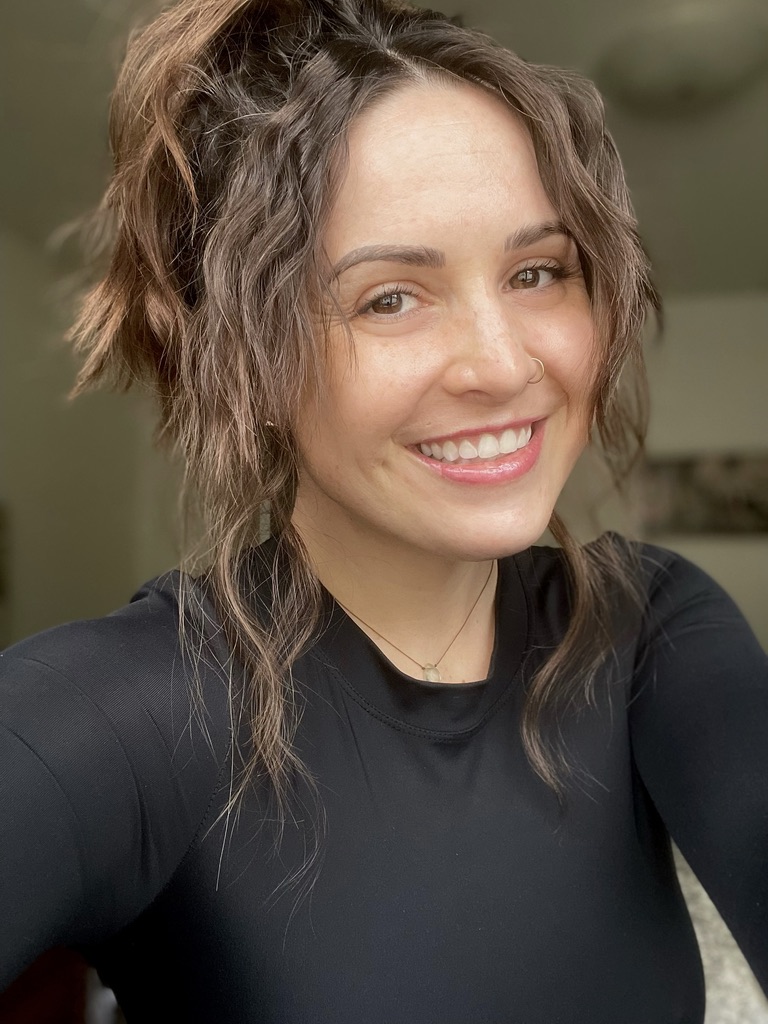
Philosophy was new terrain for me, and I was enamored with it. It dealt with societal and cultural problems, promoted critical thinking, and examined abstract concepts and ideas, providing a setting to ask the bigger questions (which I was always doing secretly behind the chair). The bigger questions I found myself asking were: How do we decide what beauty is? What are the evolutionary benefits of beauty, and how has it evolved? What are the psychological and societal impacts of what is considered beautiful? Moreover, what influences has beauty had on society, especially among women and marginalized communities? I knew, somehow and in some way, I wanted to be a part of the discourse around beauty and our aesthetic decisions, and the stars aligned, enabling me to do just that.
In 2019, I finally uncovered the roots of my illness. I was diagnosed with Ehlers-Danlos syndrome, a connective tissue disorder that causes chronic joint pain, among other issues, which led to my hands being unable to keep up with the demand of hairdressing. My career as a cosmetologist was over. So, I decided to go to college for the first time and major in philosophy. The shift from beauty service provider to aesthetic scholar has been interesting, and the intersection of scholarship and tradesperson is one I wish happened more frequently. After finishing my associate’s degree at Ivy Tech community college in 2021, I transferred to Indiana University.
I wasn’t sure if IU was the best institution for me to focus on aesthetics; however, the week before classes started, I discovered the university had an Individualized Major Program. During my first year at IU, I crafted my own curriculum that focused on interdisciplinary study. A board approved my major in late spring of 2022, and I am now double majoring in Philosophy and Applied Aesthetics. Applied Aesthetics highlights our cultural constructs around aesthetics and their functionality within a culture. Understanding aesthetics as applied in society provides a trackable evolution in our ideologies. This can be historical, political, psychological, sociological, anthropological, and economical, allowing us to comprehend the current state of the human condition through our likes and dislikes translated through our self-expression.
Beauty is deeply ingrained into cultures and societies, but also us. And our concepts of beauty are shifting, especially in the digital age we are in, which means new discourse arises about how our ideals around aesthetics evolve. Our personal aesthetic decisions influence trends and fashion in our communities. Those decisions potentially move society in new directions, inspiring growth, evolution, and innovation, and I’m eager to see where our aesthetic choices take us next.
This post is extremely radiant. I extremely like this post. It is outstanding among other posts I’ve read in quite a while. Much obliged for this better-than-average post. I truly value it!
LikeLike